sydney neurosurgeon professor brian owler
What Is A Spondylolisthesis symptoms treatment Indications For Surgery

Spondylolisthesis Treatment in Sydney

What is the anatomy of the lumbar spine?

The lumbar spine consists mainly of the vertebrae or bone of the spine with a disc in between each bone. There are five lumbar vertebrae (referred to as L1-5). The main part of the vertebra is called the body and is located towards the front. The disc is located between the vertebral bodies. Each disc is referred to by the bones between which it sits. For example, the L4/5 disc is located between the L4 and L5 vertebral bodies.

Behind the vertebral bodies there is a ring of bone that contains the bottom of the spinal cord which ends at L1/2 and the nerve roots. The back of this ring is made of the lamina and spinous processes to which several muscles are attached. For most of the lumbar spine, there is a group of nerve roots which trail down from the bottom of the spinal cord. The nerve roots, which are surrounded by spinal fluid and which are enclosed in a sac called the dura, are referred to as the cauda equina which translates to ‘horse’s tail’. 
Spondylolisthesis Treatment in Sydney

What is a spondylolisthesis?

Spondylolisthesis is a condition where one vertebral body moves forward in relation to the next. This forward ‘slip’ can occur for a variety of reasons. The most common varieties of spondylolisthesis are:

Degenerative spondylolisthesis

Degenerative spolndylolisthesis occurs mainly in women and occurs most commonly at the L4/5 level. Degenerative spondylolisthesis is due to degenerative changes in the facet joints at the posterior aspect of the spine. The loss of integrity in these joints allows the superior vertebra to move forward. This results in narrowing of the spinal canal or spinal stenosis, as well as narrowing of the exit foramina for the individual nerve roots.

Isthmic spondylolisthesis

Isthmic spondylolisthesis is a condition that is more common in males and occurs mostly at the L5/S1 level. It occurs when there are pars defects. The pars (or pars interarticularlis) are small areas of bone; one each side at the posterior aspect of the spine. It joins one facet joint to another. When the pars are fractured, or have a defect, the main part of the superior vertebra is allowed to ‘slip’ forward. In most cases this is a small slip, but it can be quite severe and rarely, the superior bone can have completely ‘slipped’ off the one below. This is called spondyloptosis and is fortunately very rare.

Isthmic spondylolisthesis is common but rarely requires surgery. The problems and their symptoms that occur due to isthmic spondylolisthesis are very similar to those described for degenerative spondylolisthesis. Surgery for this condition is performed only in patients who have significant symptoms that have not responded to more conservative treatment. Therefore, only a minority of people with this condition will require surgery during their lifetime.

Other forms of spondylolisthesis

Other forms of spondylolisthesis include trauma, congenital spinal dysplasia, tumour and infection.

What are the symptoms of a lumbar disc protrusion?

Most disc protrusions are probably asymptomatic. This means that they cause little or no clinical problems for the patient. They are often small and are frequently noted on CT or MRI scans. These asymptomatic disc bulges or protrusions need no treatment. The aim of treatment is to improve the patient’s symptoms rather than just improve the appearance of the CT/MRI scans.

Other patients will experience very significant symptoms. The most common is pain. This includes both lower back pain and leg pain. The leg pain is often called radicular pain, or more commonly, sciatica. Symptoms of lumbar disc protrusions can be classified as:

What are the symptoms of spondylolisthesis?

Radiculopathy

Radiculopathy, often called a pinched nerve or sciatica, occurs when a nerve root is compressed as it exits the spinal cord. Nerve roots provide sensation to specific body areas and control muscle movement.

This condition typically causes pain in the area served by the affected nerve and may also lead to numbness, tingling (paraesthesia), or muscle weakness. The symptoms often help identify which nerve root is involved.

Radiculopathy is most commonly caused by disc protrusions or bony spurs (osteophytes). In spondylolisthesis, the space where the nerve exits the spine (foramen) narrows, and compression can also occur within the spinal canal.

Neurogenic claudication

Neurogenic claudication refers to pain, numbness and/or paraesthesia (pins and needles) that occurs during standing or walking. Typically, the symptoms begin when the patient walks long distances only and is relieved by a few minutes of rest after which they can walk again for a similar distance. Over time, as the condition progresses, the distance for which the patient can walk, or time that they can stand for, is reduced.

Eventually the symptoms become so severe that they occur at rest and may significantly limit mobility. The most common reason for this condition is a spinal canal stenosis which is a consequence of spondylolisthesis. This means that the space inside the spinal canal has become too small for the nerves. Essentially, they become crowded together and compressed.

Mechanical back pain

The low back pain that people experience in this condition can take several forms. Typically, patients find that small degrees of flexion (bending forward) can cause significant pain. An example of this is experiencing pain while leaning over a sink to brush their teeth.

However, they often also report that the pain is relieved by supporting their upper body on their elbows. For example, they find that leaning forward on the handle of the shopping trolley is more comfortable than when they walk straight upright.

What type of surgery is used to treat spondylolisthesis?

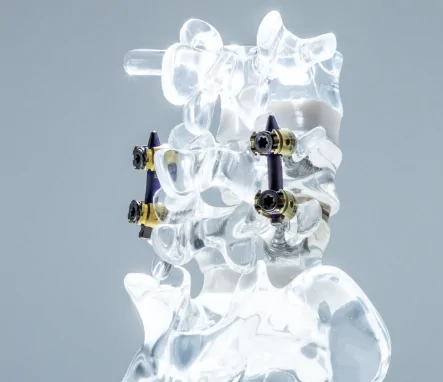
Surgery for spondylolisthesis usually involves a technique that will both decompress the affected nerve, but also restore stability and alignment to the lumbar spine. A number of factors are taken into account including the degree of the spondylolisthesis, the level, and number of levels involved, the overall alignment of the spine, and patient preferences.

For most patients, a decompression and fusion procedure will be performed. This may be in the form of a posterior lumbar interbody fusion (PLIF) which may be performed using an open or minimally invasive technique. Some patients may be better suited to minimally invasive approaches such as an extreme lateral interbody fusion (XLIF). Prof Owler will be able to discuss this with you at your consultation.

To learn more about treatments for Spondylolisthesis click on one of the following links:
What are the treatment options for spondylolisthesis
Website by Image Traders