
Presented by Dr Vijidha Shree Rajkumar at EUROSPINE 2025 in Copenhagen, this multi-centre study highlights the safety and efficacy of Prone Transpsoas fusion.
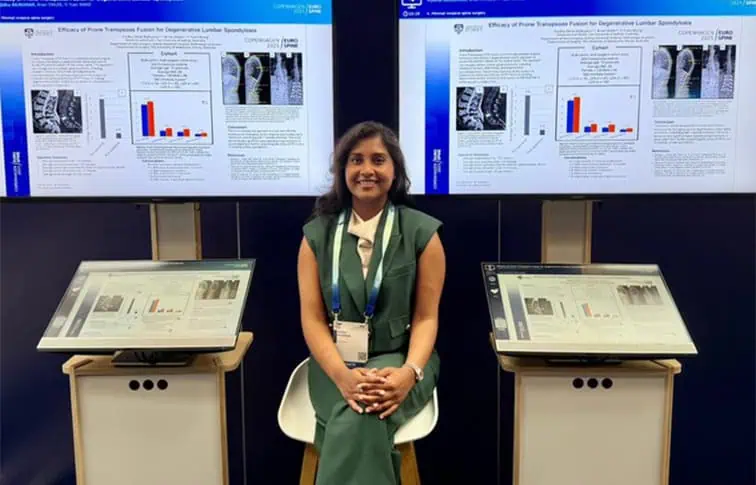
At the EUROSPINE 2025 Congress in Copenhagen, Dr Vijidha Shree Rajkumar presented new findings on the Prone Transpsoas (PTP) fusion technique supported by ATEC Spine, highlighting its safety, precision, and effectiveness in managing degenerative lumbar spine conditions. The multi-centre research, conducted in collaboration with Professor Brian Owler and Dr Yi Yuen Wang, adds to the growing body of evidence supporting the use of this minimally invasive approach for conditions such as lumbar spondylosis, spondylolisthesis, and degenerative scoliosis.
The Prone Transpsoas technique allows surgeons to access both the anterior and posterior spinal columns in a single operative position. Using a lateral approach through the psoas muscle while the patient remains prone, surgeons can perform anterior column fusion and posterior fixation in one stage.
This single-position workflow not only increases surgical efficiency but also reduces anaesthetic time, operative duration, and patient repositioning. For patients, this translates to less tissue disruption, shorter hospital stays, and faster recovery.
The multi-centre, multi-surgeon study evaluated 204 consecutive patients (108 female and 96 male) with a mean age of 72 years and an average BMI of 28. Across the group, a total of 282 interbody fusions were performed at lumbar levels L1/2 (n=16), L2/3 (n=42), L3/4 (n=89), and L4/5 (n=135).
The average anaesthetic time was 170 minutes, with a total operative time of 115 minutes. The lateral operative time for the anterior column fusion averaged 39 minutes, and psoas retraction time averaged 14 minutes. The average hospital stay following surgery was four days.
Radiological assessments showed significant post-operative improvements across all major parameters:
Among 107 patients with degenerative spondylolisthesis, combining anterior column fusion with posterior pedicle screw fixation produced marked alignment correction. The average vertebral slip decreased from 5.8 mm pre-operatively to 0.8 mm post-operatively (P < 0.001).
One case presented involved a 78-year-old female with severe back pain, neurogenic claudication, and L4 radiculopathy associated with degenerative scoliosis.
This case illustrated how PTP fusion can deliver both sagittal and coronal balance correction while maintaining a minimally invasive profile.
The study reported no major vascular or visceral complications.
Minor events included:
These findings demonstrate a low overall complication rate, consistent with earlier literature on the technique’s safety.
The results presented at EUROSPINE 2025 confirm the Prone Transpsoas fusion as a safe and reproducible technique for degenerative lumbar conditions. It delivers meaningful spinal realignment, effective decompression, and shorter recovery times, all within a minimally invasive framework.
For surgeons, the single-position workflow streamlines the operative process, while for patients, it reduces the physical toll of surgery and hospital recovery.
The data presented by Dr Vijidha Shree Rajkumar at EUROSPINE 2025 in Copenhagen reinforces the clinical value of Prone Transpsoas fusion as a next-generation surgical approach for degenerative spine disease. With measurable improvements in spinal parameters, a short hospital stay, and minimal complications, PTP fusion stands out as a reliable and effective solution for modern spinal care.
