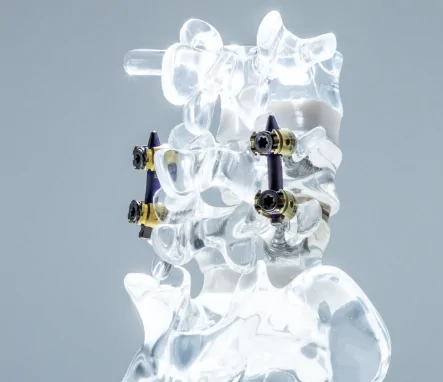
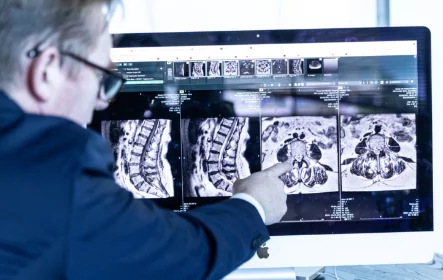
What is a spondylolisthesis?
Spondylolisthesis is a condition where one vertebral body moves forward in relation to the next. This forward ‘slip’ can occur for a variety of reasons. The most common varieties of spondylolisthesis are:
Degenerative spondylolisthesis
Degenerative spolndylolisthesis occurs mainly in women and occurs most commonly at the L4/5 level. Degenerative spondylolisthesis is due to degenerative changes in the facet joints at the posterior aspect of the spine. The loss of integrity in these joints allows the superior vertebra to move forward. This results in narrowing of the spinal canal or spinal stenosis, as well as narrowing of the exit foramina for the individual nerve roots.
Isthmic spondylolisthesis
Isthmic spondylolisthesis is a condition that is more common in males and occurs mostly at the L5/S1 level. It occurs when there are pars defects. The pars (or pars interarticularlis) are small areas of bone; one each side at the posterior aspect of the spine. It joins one facet joint to another. When the pars are fractured, or have a defect, the main part of the superior vertebra is allowed to ‘slip’ forward. In most cases this is a small slip, but it can be quite severe and rarely, the superior bone can have completely ‘slipped’ off the one below. This is called spondyloptosis and is fortunately very rare.
Isthmic spondylolisthesis is common but rarely requires surgery. The problems and their symptoms that occur due to isthmic spondylolisthesis are very similar to those described for degenerative spondylolisthesis. Surgery for this condition is performed only in patients who have significant symptoms that have not responded to more conservative treatment. Therefore, only a minority of people with this condition will require surgery during their lifetime.
Other forms of spondylolisthesis
Other forms of spondylolisthesis include trauma, congenital spinal dysplasia, tumour and infection.